
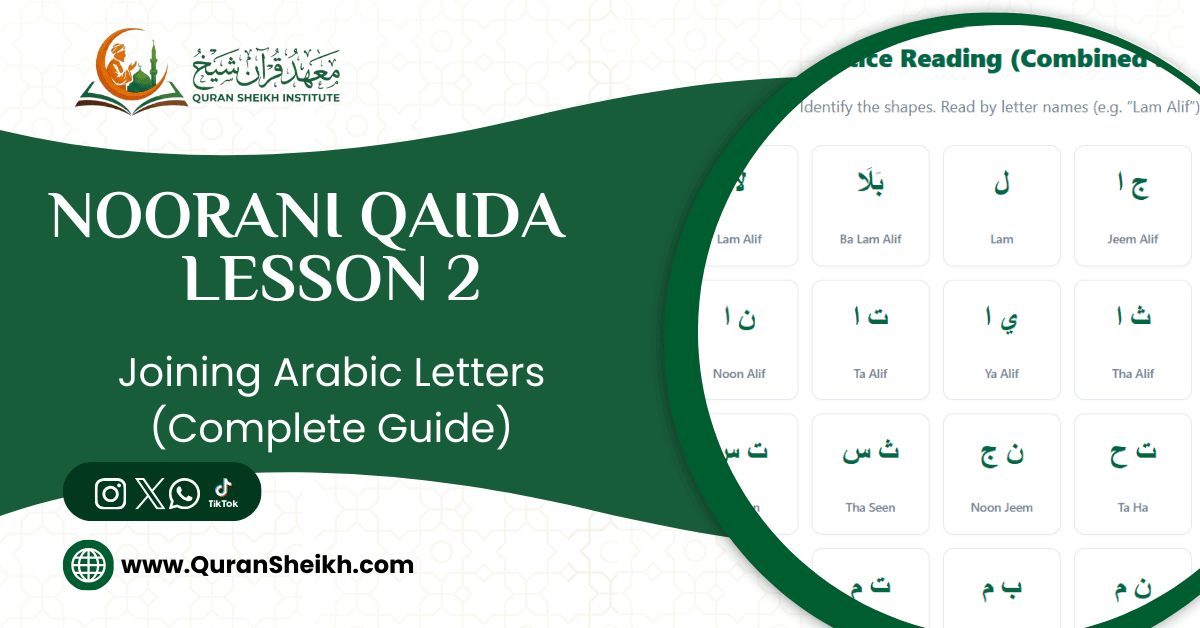
You’ve mastered the individual letters. Now, let’s watch them hold hands! 🤝
Welcome to Lesson 2. This is where the real magic of reading begins. In the previous lesson, you learned the letters in their “independent” forms (standing alone). But in the Quran, letters rarely stand alone; they connect to form beautiful words.
Think of Arabic letters as friendly neighbors. When they meet, they change their shapes slightly to connect with one another. In this lesson, we will guide you to recognize these changing shapes so you can read any compound word with confidence.
✨ Why is this lesson crucial? Because 99% of the Quran consists of connected letters. Mastering this lesson means you have cracked the code of Arabic reading!
Ready to solve the puzzle? Let’s dive in! 👇
📖 Practice Reading (Combined Shapes)
Identify the shapes. Read by letter names (e.g. “Lam Alif”).
Lam Alif
Lam Alif
Ba Lam Alif
Lam
Jeem Alif
Lam Alif
Meem Alif
Ba Alif
Noon Alif
Ta Alif
Ya Alif
Tha Alif
Ba Seen
Ya Seen
Noon Seen
Ta Seen
Tha Seen
Noon Jeem
Ta Ha
Noon Kha
Ya Ha
Ba Jeem
Ba Kha
Ta Meem
Ba Meem
Noon Meem
Ya Meem
Tha Meem
Ba Ya
Noon Ya
Ta Ya
Tha Ya
Ya Ya
Noon Lam
Ta Lam
Ba Lam
Ya Lam
Tha Lam
Noon Ha
Meem Ha
Ya Ha
Ba Ha
Ha
Ta Ha
Ain Za
Saad Dal
Taa Ba
Daad Dal
📺 Watch the Full Lesson: Listen & Repeat

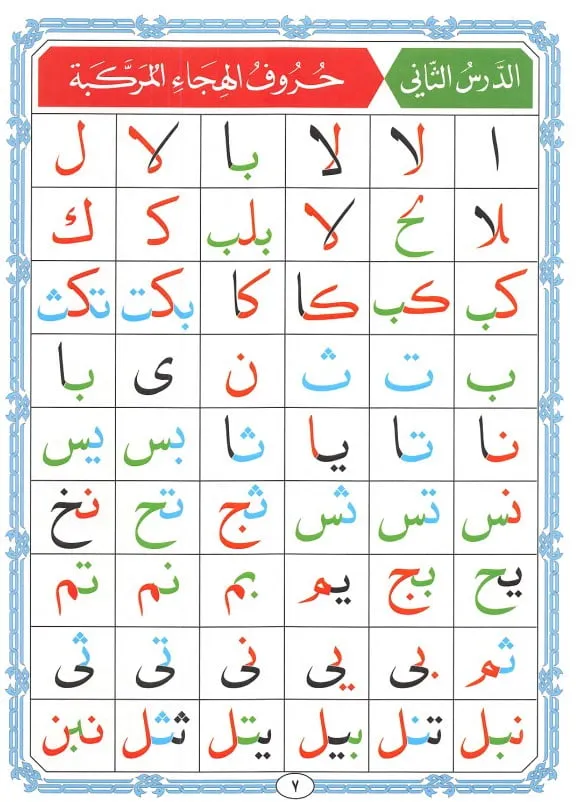
The Secret of “Shape-Shifting” Letters
Arabic letters are like shapeshifters! Their look depends on where they sit in a word. Here is the simple rule:
1. The Beginning (Initial)
When a letter starts a word, it usually loses its “tail” and stretches its hand to the left to catch the next letter.
Example: ( بـ ) instead of ( ب )
2. The Middle (Medial)
When a letter is in the middle, it has two hands! One connects to the right, and one to the left.
Example: ( ـبـ ) connecting both sides.
3. The End (Final)
When a letter finishes a word, it often goes back to its original full shape (sometimes with a small tail connecting to the right).
Example: ( ـب ) closing the word.
Six letters never connect to the left (after them). They are:
( ا ، د ، ذ ، ر ، ز ، و ).
They force the next letter to start a new shape!
💡 Golden Tips to Master Combined Letters
1. Look at the “Head”, Ignore the “Tail”
Most Arabic letters are recognized by their “Head” (top part). The body or tail often gets cut off when joining. Focus on the dots and the head shape!
2. The “Dots” are Your GPS
Shape changes can be confusing, but dots never lie!
• 1 dot below = Baa (ب)
• 2 dots above = Taa (ت)
• 3 dots above = Thaa (ث)
Always count the dots first.
3. The Tricky “Ha” (هـ)
The letter Ha (هـ) changes the most! It looks like a circle (ه), a ribbon (ـهـ), or a teardrop (ـه). Don’t worry, we will practice all its faces.
📥 Take the Classroom Home
Download the Complete Noorani Qaida PDF (Free)
Don’t let the learning stop here. Get the exact book used by our Sheikhs. High-quality, clear script, and perfect for offline practice on any device.
- ✅ Crystal Clear Arabic Script
- ✅ Compatible with Mobile & Tablet
- ✅ 100% Free for Students
File size: Lightweight & Fast (PDF)
🎓 For Teachers: The Science of Connected Script
Click to explore the rules of “Rasm” (Script) and why letters change shapes.
1. The “Generic Tooth” Phenomenon (Nabrah) 🦷
In Arabic Calligraphy (Naskh script), five distinct letters lose their unique bodies and transform into a generic “Tooth” or spike (Nabrah) when they are in the Initial or Medial position:
- Baa (ب), Taa (ت), Thaa (ث)
- Noon (ن), Ya (ي)
The Teaching Point: Explain to students that without the dots, these 5 letters look exactly the same. The “Dot” is the only identifier.
2. The “Stubborn Six” (Non-Connectors) 🛑
These six letters are scientifically called “Huruf Infisal” (Letters of Separation). They allow a connection from the right (before them) but refuse to connect to the left (after them).
The List: ( ا ، د ، ذ ، ر ، ز ، و )
Visual Rule: Whenever one of these appears, it creates a “Break” in the visual line of the word, forcing the next letter to take its “Initial” shape again.
3. The Many Faces of Letter Haa (هـ) 🎭
The letter Haa (هـ) is unique because its shape changes completely depending on its position:
- Initial: Looks like a large circle with a smaller circle inside (هـ).
- Medial: Often looks like a bow-tie or number 8 (ـهـ) in some scripts, or a descending loop.
- Final (Connected): Looks like a flag or a neck (ـه).
- Final (Disconnected): Looks like a teardrop or circle (ه).
Master the Art of Quran Recitation
Don’t rely on self-study alone. Get your pronunciation checked by a certified Al-Azhar Sheikh today.
- ✨ 1-on-1 Live Private Session
- ✨ Native Arab Tutors (Male & Female)
- ✨ 100% Free Evaluation – No Commitment
🔒 No Credit Card Required
💬 Common Questions About Lesson 2
How long does it take to master Lesson 2 (Compound Letters)?
How do I tell the difference between Baa, Taa, Tha, and Noon in connected forms?
- Baa (ب): 1 dot below.
- Noon (ن): 1 dot above.
- Taa (ت): 2 dots above.
- Tha (ث): 3 dots above.
Why does the letter Haa (هـ) look so different in the middle?
- Start: Like a big circle (هـ).
- Middle: Looks like a bow-tie or figure-8 (ـهـ).
- End: Looks like a flag (ـه) or a teardrop (ه).
How can I distinguish between Alif and Laam in a word?
Which Arabic letters never connect to the left?
I find it hard to recognize letters when they are stacked. What should I do?
Do I need a teacher for Lesson 2?
Unlocking the Code! 🔓
Great job! You are no longer looking at individual bricks; you are starting to see the wall. By understanding how letters join, you have taken a massive leap towards reading actual Quranic verses.
What’s Next? Now that you can recognize connected letters, it’s time to challenge yourself with “Muqatta’at” (Disjoined Letters) in the next lesson.
Want to see the full roadmap?
Access the complete Noorani Qaida Syllabus (All 17 Lessons)
🎓 Ready to Level Up?
Don’t just read alone. Join our live classes with expert Sheikhs.