
The Ultimate Sukoon Workout: Build Your Fluency 💪
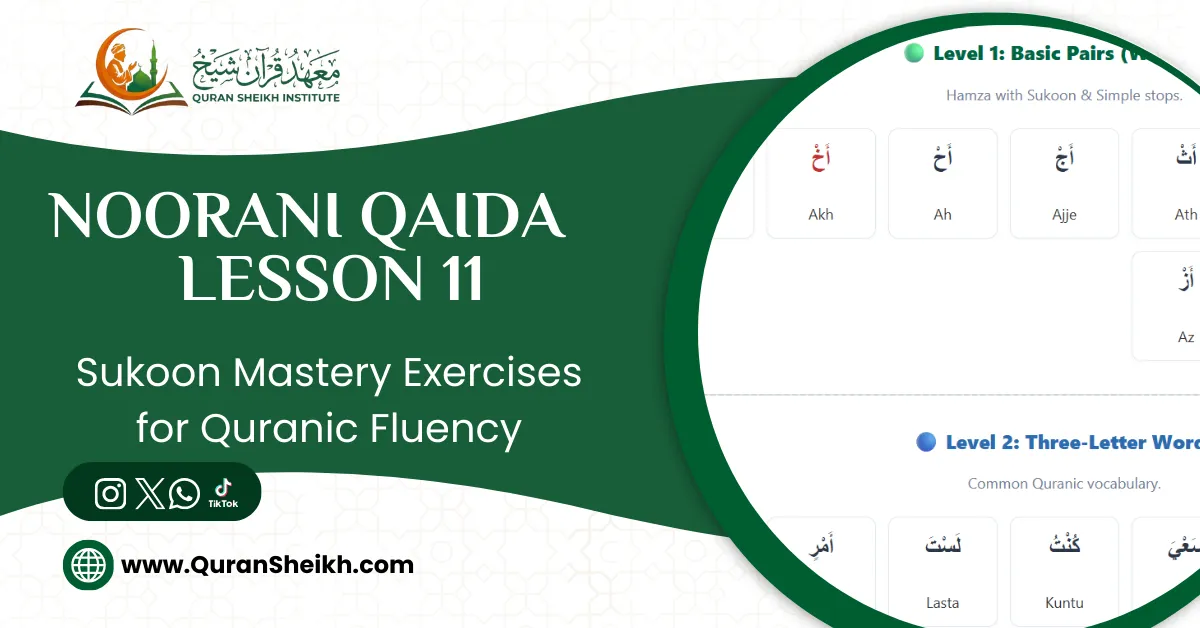
Welcome to Lesson 11. This is not just another lesson; it is the “Bridge” between reading letters and reading the Quran.
In this lesson, we combine everything you’ve learned: Harakat (Movements) + Sukoon (Stops). You will practice shifting gears instantly from moving to stopping without losing rhythm.
Ready to test your skills? Let’s begin the training! 👇
Abbe
At-h
Ath
Ajje
Ah
Akh
Adde
Ath
Arr
Az
🔵 Level 2: Three-Letter Words
Common Quranic vocabulary.
Ba’du
Batsha
Sa’ya
Kuntu
Lasta
Amrin
Bardan
Jam’an
Hablun
Khusrin
🔴 Level 3: Pro Challenge (Complex Words)
Qalqalah in the middle & Heavy letters.
Yad-khuluna
Yaj-‘aluna
Yan-zuruna
Ta’-buduna
An-‘amta
An-zarnaa
Khalaq-naa
Rafa’-naa
Wada’-naa
Musfiratun
📺 Watch the Full Lesson: Listen & Repeat

🧬 How to “Flow” Through the Stop
The secret to reading complex words smoothly.
1. The Sharp Stop
For most letters, the Sukoon is a sharp brake. Do NOT let the sound drag or bounce (unless it’s Qalqalah).
An-ta
2. No Gaps Allowed
Do not pause between the letters of one word. Connect the resting letter immediately to the next one.
Right: Anta
💡 Golden Tips for Lesson 11
1. Don’t “Birth” a Sound (Tawallud)
A common mistake is adding a vowel after a Sukoon (e.g., saying “An-na-ta” instead of “An-ta”). Keep the stop clean and sharp.
2. Watch the Heavy Letters
When letters like (خ – ص – ض – ط – ظ – غ – ق) have a Sukoon, keep them heavy/full-mouth, but don’t move them with a vowel.
3. The “Raa” Rule
Remember Lesson 10? Check the letter before the Raa. Fatha/Damma = Heavy Raa. Kasra = Light Raa. Apply this to words like (أَرْسَلَ vs فِرْعَوْن).
📥 Take the Classroom Home
Download the Complete Noorani Qaida PDF (Free)
Don’t let the learning stop here. Get the exact book used by our Sheikhs. High-quality, clear script, and perfect for offline practice on any device.
- ✅ Crystal Clear Arabic Script
- ✅ Compatible with Mobile & Tablet
- ✅ 100% Free for Students
File size: Lightweight & Fast (PDF)
🎓 For Teachers: Assessing Fluency
1. Detecting “Sakt” (Unintended Pause)
2. Hams vs. Qalqalah
Master the Art of Quran Recitation
Don’t rely on self-study alone. Get your pronunciation checked by a certified Al-Azhar Sheikh today.
- ✨ 1-on-1 Live Private Session
- ✨ Native Arab Tutors (Male & Female)
- ✨ 100% Free Evaluation – No Commitment
🔒 No Credit Card Required
💬 Common Questions About Lesson 11
Mastering the toughest Sukoon challenges.
What is the main goal of Lesson 11?
To build fluency. Unlike Lesson 10 which introduced the concept, Lesson 11 forces you to apply Sukoon in longer, complex Quranic words.
How do I read (أَنْتَ) without stuttering?
Focus on the Noon. Make the ‘N’ sound clearly and immediately move your tongue to the ‘Ta’ position without breaking your breath.
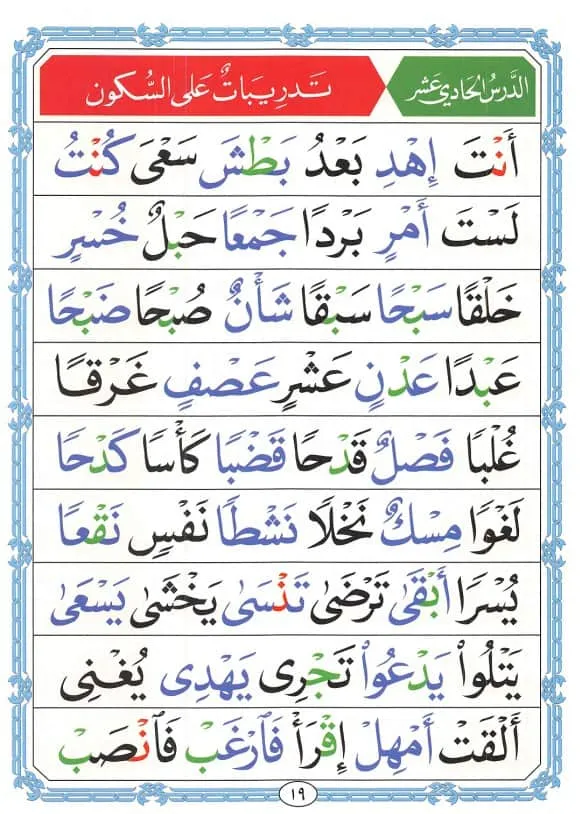
Why are some letters Red in the book?
In standard Noorani Qaida books, red letters often indicate Qalqalah (Bouncing letters: Qaaf, Taa, Baa, Jeem, Dal) to remind you to bounce them.
How to handle Hamzatul-Wasl (ٱ) in this lesson?
If it’s in the middle of a sentence (like Wal-asr), you skip it. If you start with it (like Ihdina), you pronounce it usually with a Kasra or Damma depending on the 3rd letter.
What is “Hijja” vs. “Rawan”?
Hijja is spelling out (Alif Fatha Noon Sukoon -> An). Rawan is direct reading (Anta). In Lesson 11, try to read with Rawan.
Why is (ر) heavy in (أَرْسَلَ)?
Because the letter before it (Alif/Hamza) has a Fatha. Fatha makes the Sukoon Raa heavy and full-mouth.
I run out of breath reading long words. Why?
You might be stressing individual letters too much. Relax your jaw and let the air flow. Sukoon is a “resting” sound, not a “stressing” sound.
Fluency Unlocked! 🔓
Great job! You have completed the most extensive practice on Sukoon. Your tongue is now flexible enough to handle pauses in the middle of Quranic verses.
Want to see the full roadmap?
Access the complete Noorani Qaida Syllabus (All 17 Lessons)
🎓 Ready to Level Up?
Don’t just read alone. Join our live classes with expert Sheikhs.