
Unlock the “Musical Ending” of Arabic Words! 🎶
Welcome to Lesson 5. You have mastered the short vowels (Harakat). Now, let’s double them up! This lesson introduces Tanween (Nunation).
What is the secret of Tanween?
It looks like a double vowel, but it sounds like a hidden “Noon” (ن). Think of it as a “Bell Ring” at the end of the word.
- 🔔 Fathatain (ً) = “An” sound (like in ‘Run’)
- 🔔 Kasratain (ٍ) = “In” sound (like in ‘Pin’)
- 🔔 Dammatain (ٌ) = “Un” sound (like in ‘Fun’)
✨ The Golden Rule: You pronounce the vowel first, then ring the bell (add the ‘N’ sound). Example: Ba + Fatha = “Ba” → Ba + Tanween = “Ban”.
Ready to make the letters ring? Let’s go! 👇
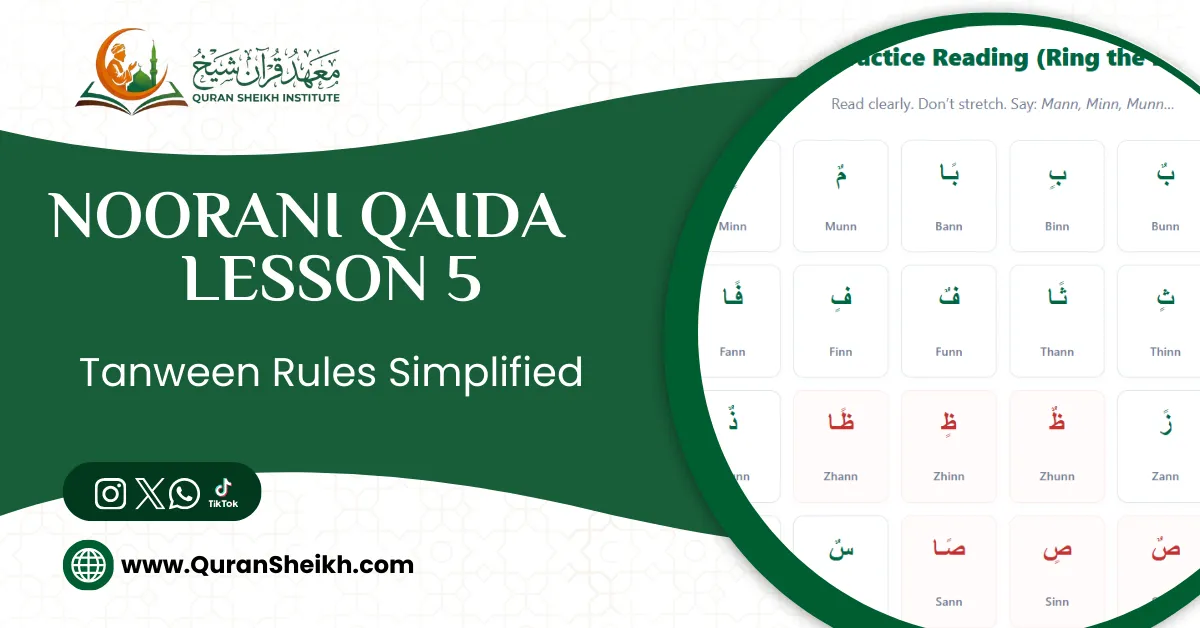
📖 Practice Reading (Ring the Bell!)
Read clearly. Don’t stretch. Say: Mann, Minn, Munn…
Mann
Minn
Munn
Bann
Binn
Bunn
Wann
Winn
Wunn
Fann
Finn
Funn
Thann
Thinn
Thunn
Thann
Thinn
Thunn
Zhann
Zhinn
Zhunn
Zann
Zinn
Zunn
Sann
Sinn
Sunn
Sann
Sinn
Sunn
Tann
Tinn
Tunn
Dann
Dinn
Dunn
Tann
Tinn
Tunn
Rann
Rinn
Runn
Nann
Ninn
Nunn
Lann
Linn
Lunn
Dann
Dinn
Dunn
Yann
Yinn
Yunn
Shann
Shinn
Shunn
Jann
Jinn
Junn
Kann
Kinn
Kunn
Qann
Qinn
Qunn
Khann
Khinn
Khunn
Ghann
Ghinn
Ghunn
Hann
Hinn
Hunn
‘Ann
‘Inn
‘Unn
Hann
Hinn
Hunn
‘Ann
‘Inn
‘Unn
📺 Watch the Full Lesson: Listen & Repeat

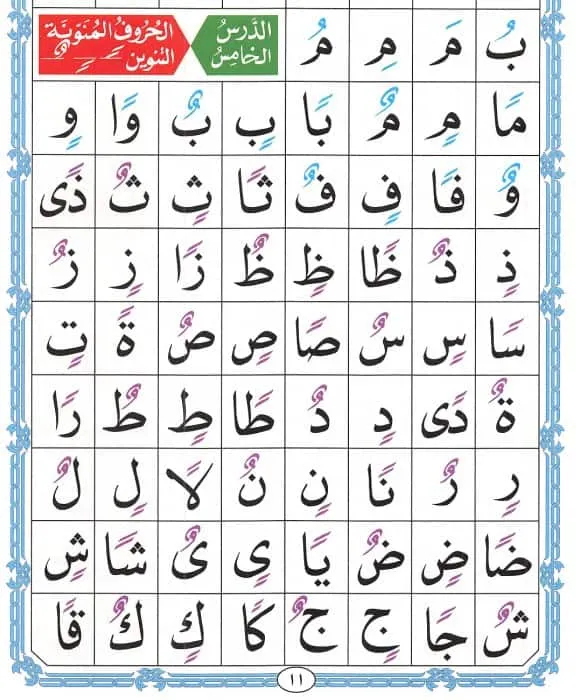
The “Tanween Formula” 🧪
It’s simple math: Vowel + Noon = Tanween
Double Fatha (An)
Open mouth + touch roof of mouth with tongue.
Double Kasra (In)
Smile/Drop jaw + touch roof of mouth with tongue.
Double Damma (Un)
Circle lips + touch roof of mouth with tongue.
💡 Golden Tips to Master Tanween
1. The “Extra Alif” Mystery 🧐
You will notice that Fathatain (ً) usually brings a friend: an extra Alif (e.g., بًا). Do not pronounce this Alif! It is silent and just acts as a “chair” for the Tanween. Just say “Ban”.
2. Tongue Position 👅
To make the perfect “N” sound at the end, the tip of your tongue must touch the hard palate (roof of the mouth) right behind your top teeth. Try it: Ba… (tongue up) …n.
3. Don’t Stretch the “N”
Unless you are learning advanced Tajweed (Ghunnah rules), keep the “N” sound short and clear for now. “Ban”, not “Bannnn”. Simplicity is key in this lesson.
📥 Take the Classroom Home
Download the Complete Noorani Qaida PDF (Free)
Don’t let the learning stop here. Get the exact book used by our Sheikhs. High-quality, clear script, and perfect for offline practice on any device.
- ✅ Crystal Clear Arabic Script
- ✅ Compatible with Mobile & Tablet
- ✅ 100% Free for Students
File size: Lightweight & Fast (PDF)
🎓 For Teachers: The Science of “Noon Sakinah”
Understanding the grammar behind the sound.
1. Tanween is “Non-Permanent” ⏳
Explain to students that the “N” sound of Tanween only exists when we continue reading. If we stop (Waqf) at the word, the Tanween often disappears or changes. It is not a written letter “Noon”.
2. The Shape of Dammatain 🔁
In the Uthmani script (Madani Mushaf), Dammatain can look like two Dhammahs (ُُ) or a Dhammah with a small curve (69 shape). Both mean “Un”. Teach students to recognize both forms.
Master the Art of Quran Recitation
Don’t rely on self-study alone. Get your pronunciation checked by a certified Al-Azhar Sheikh today.
- ✨ 1-on-1 Live Private Session
- ✨ Native Arab Tutors (Male & Female)
- ✨ 100% Free Evaluation – No Commitment
🔒 No Credit Card Required
💬 Common Questions About Lesson 5
Why is it called “Tanween”?
What is the difference between Nun (ن) and Tanween?
Why does Fathatain have an Alif (e.g., بًا)?
Does Tanween ever come in the middle of a word?
How do I pronounce Tanween with heavy letters (like Qaf)?
Can Tanween appear with Alif Lam (ال)?
What happens if I stop on a word with Tanween?
You’ve Unlocked the “Hidden Noon”! 🌟
Congratulations on completing Lesson 5. You no longer just see “double lines”; you now hear the musical “ring” of the Tanween. You have successfully added a crucial layer to your Quranic reading skills.
What’s Next? Theory is great, but practice makes perfect! Now that you know Harakat (Lesson 4) and Tanween (Lesson 5), it’s time to mix them up.
In the next lesson, we will challenge your focus with comprehensive exercises combining everything you’ve learned so far. Ready for the challenge?
Want to see the full roadmap?
Access the complete Noorani Qaida Syllabus (All 17 Lessons)
🎓 Ready to Level Up?
Don’t just read alone. Join our live classes with expert Sheikhs.